
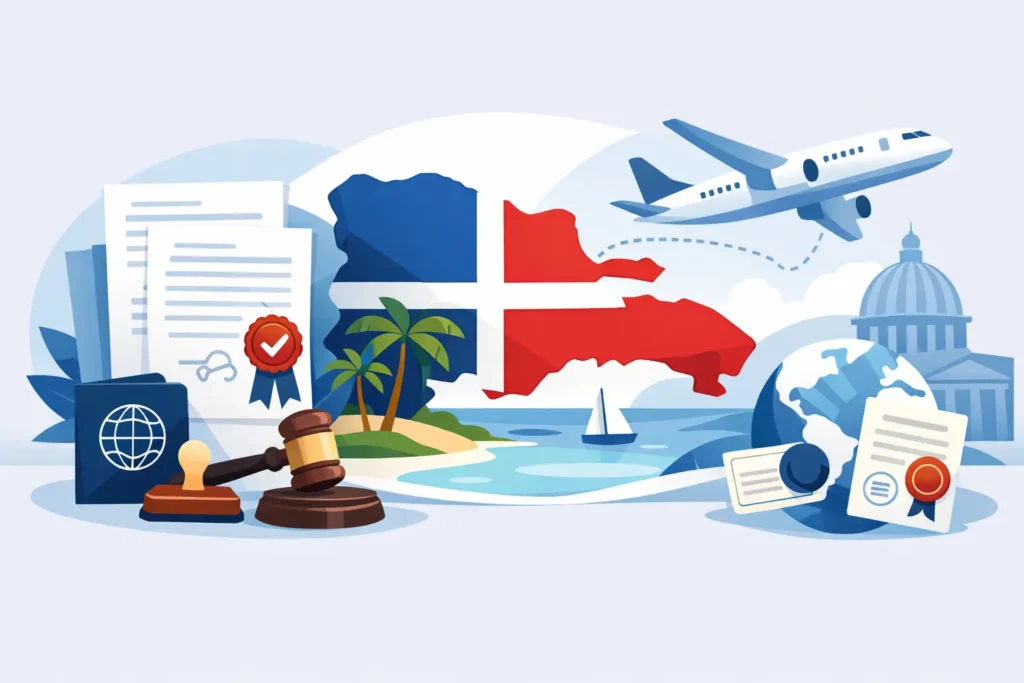
A birth certificate issued in the United States may be perfectly valid at home and still be rejected for a Dominican residency application if it has not been properly authenticated. The same issue can affect marriage certificates, police clearances, diplomas, powers of attorney, and corporate records. Knowing how to legalize foreign documents before you begin your move can prevent expensive delays at a critical stage of your Dominican Republic plans.
For most foreign nationals, document legalization is not a single stamp. It is a sequence that confirms a document is genuine, makes it acceptable for use abroad, and, when necessary, puts it into Spanish. The right sequence depends on the country that issued the document, the type of document, and the Dominican authority that will receive it.
What “Legalization” Means in the Dominican Republic
People often use the word “legalization” to describe any process that makes a foreign document usable in another country. Technically, there are two different paths: an apostille and consular legalization.
An apostille is used between countries that participate in the Hague Apostille Convention. The Dominican Republic and the United States are both member countries. For documents issued in the United States, an apostille generally replaces the longer process of obtaining Dominican consular legalization. It confirms the signature, seal, or authority of the public official who issued or certified the document.
Consular legalization is generally required when a document comes from a country that is not part of the Hague Convention. That route may involve certification by the issuing authority, authentication by the foreign ministry in the country of origin, and legalization through the Dominican consulate. Because procedures vary by country, it requires closer planning.
Neither process verifies that every statement inside a document is true. Instead, it verifies that the document or official signature is authentic. Dominican immigration offices, banks, courts, and business registries may still review whether the document meets their substantive requirements.
Start With the Receiving Authority’s Requirements
Before ordering records or sending anything for an apostille, identify exactly why you need each document. A residency application, a company formation, a real estate transaction, and a Dominican bank account can require different versions of the same record.
For immigration matters, common documents include a long-form birth certificate, a marriage certificate when applicable, a divorce decree or death certificate for prior marriages, and a criminal background check. Investors and entrepreneurs may also need certificates of incorporation, good-standing certificates, board resolutions, powers of attorney, or financial records.
Ask these practical questions at the start: Does the authority require an original or a certified copy? Does it have a recent-issue requirement? Must the document be apostilled before translation? Is a Spanish translation required, and must it be completed by an authorized judicial interpreter in the Dominican Republic?
Timing matters more than many applicants expect. Police certificates and certain financial documents can become stale quickly. If you apostille them too early, you may need to obtain them again before filing. On the other hand, waiting until a visa appointment is scheduled can leave too little time for state or federal processing.
How to Legalize Foreign Documents: The Practical Process
For a U.S.-issued document intended for use in the Dominican Republic, the process usually follows a clear order.
1. Obtain the correct original or certified copy
Begin with the issuing agency. For vital records, request a certified copy from the state or local office that maintains the record. Do not assume a photocopy, hospital record, or online printout will qualify for an apostille.
For an FBI Identity History Summary, use the official FBI-issued report. If you need a state criminal record check instead, confirm that it is accepted for your particular immigration purpose before ordering it. A document that is valid for one procedure may not satisfy another.
Corporate documents require similar care. The apostille authority may require a signature from a state official, a county clerk certification, or notarization before it can issue an apostille. The format and signature requirements differ by state.
2. Identify the correct apostille authority
The location that issued the document usually determines where it must be apostilled. State-issued birth, marriage, divorce, notarized, and many corporate documents are generally apostilled by that state’s Secretary of State or equivalent authority.
Federal documents follow a different route. An FBI background check, federal court record, or document issued by a U.S. federal agency is generally authenticated through the U.S. Department of State rather than a state office. Sending a federal document to a state apostille office is a common and avoidable mistake.
If your records were issued outside the United States, consult the competent apostille authority in that country. The authority is often a ministry, court, regional government office, or designated registry, depending on local law.
3. Review the apostille before you send the document abroad
Once issued, confirm that the apostille identifies the correct country, official, signature, and document. Keep the apostille attached to the underlying record. Removing it, laminating it, or separating the pages can create questions about whether the authentication remains valid.
Scan the complete document package for your records before shipping it to the Dominican Republic. Keep in mind that many applications require original apostilled documents, not merely scanned copies. Digital files are useful for review and planning, but they do not always replace the physical documents required at filing.
4. Arrange the Spanish translation at the right stage
Foreign-language documents commonly need Spanish translations for use in Dominican legal and immigration processes. In many cases, the document should be apostilled first and then translated as a complete package, including the apostille itself.
The appropriate translation standard depends on the receiving authority. A translation prepared by an authorized judicial interpreter in the Dominican Republic is often the safest option for formal government filings. Translating the document in the United States before obtaining an apostille can lead to duplicated work if the Dominican authority requires the apostille and translation to be presented together.
5. Deliver documents while they are still current
Document validity periods are not always uniform. Immigration requirements may treat a police clearance differently from a birth certificate, while a bank can have its own recency standards for proof of income or corporate documentation. The issue date, apostille date, translation date, and submission date should all be coordinated with your filing schedule.
This is especially relevant for families relocating on a timeline. A spouse’s marriage certificate may remain usable for years, but a background check could need replacement if the visa or residency process takes longer than expected.
When Apostilles Are Not Enough
An apostille is usually the proper route for documents from Hague Convention countries, but exceptions and special requirements can arise. Documents from non-member countries may require consular legalization. Some documents may need prior certification before they qualify for an apostille. Private records, school documents, and documents signed before a notary can be particularly sensitive to procedural details.
A document can also be properly apostilled yet unsuitable for its intended purpose. For example, a short-form birth certificate may authenticate successfully but fail to show the details requested for an immigration file. A power of attorney may be valid in form but too narrowly written to permit a representative to complete a Dominican property or company transaction.
For that reason, authentication should never be treated as a stand-alone administrative task. It must match the legal purpose of the document.
Common Errors That Cause Delays
The most frequent problems are preventable. Applicants sometimes apostille a photocopy instead of a certified record, use a state apostille for a federal document, or submit a document whose issuing date is outside the permitted window. Others translate only the underlying certificate and omit the apostille page.
Another common issue is ordering a record under a name that does not match the name used in the Dominican application. Name differences caused by marriage, divorce, abbreviated middle names, or inconsistent spelling should be addressed early. Supporting documents may be necessary to establish a clear chain between identities.
Shipping also deserves attention. Original documents should be tracked, insured when appropriate, and handled through a reliable process. Replacing a lost certified record may be manageable, but replacing an apostilled document under a filing deadline can be stressful and costly.
Plan the Document Process Around Your Relocation Timeline
For a move to the Dominican Republic, document preparation works best when it is integrated with your visa, residency, investment, or business plan. Ordering every possible record months in advance is not always efficient. Waiting until the final week is riskier still.
A thoughtful review can identify what must be obtained immediately, what should wait until a filing date is closer, and what needs specialized handling. Abreu & Associates helps clients coordinate apostilles, authorized translations, and immigration documentation as part of an all-inclusive relocation process, so paperwork supports the larger move rather than holding it back.
Your documents are the foundation of your legal transition to the Dominican Republic. Give them the same care you would give your residency strategy, investment structure, or family relocation plan, and you will arrive at the filing stage prepared to move forward with confidence.