


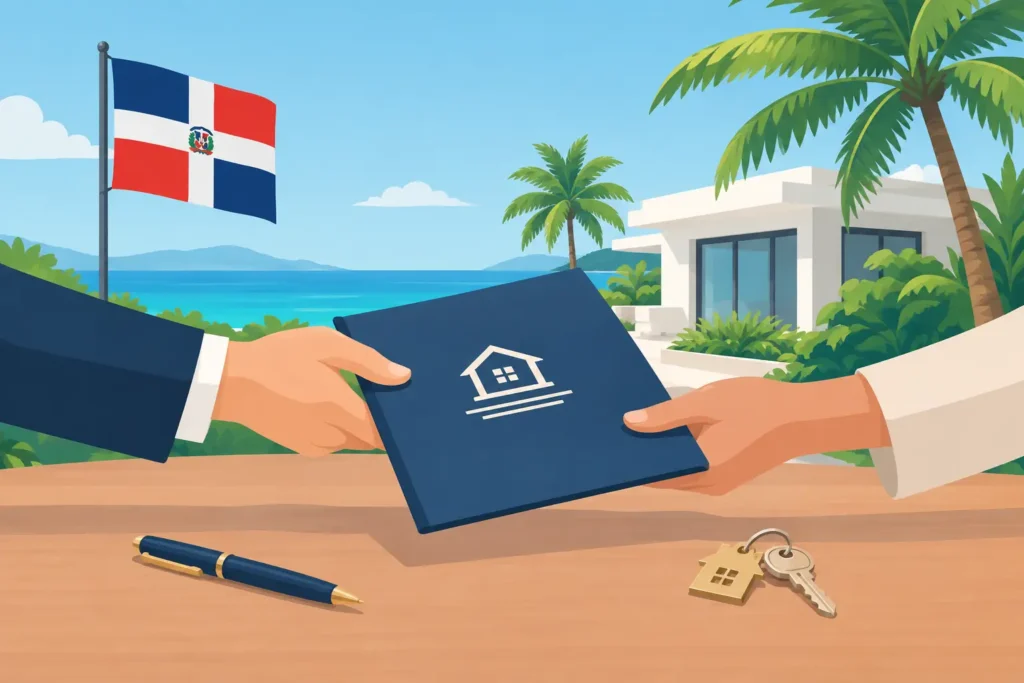
A Dominican real estate closing is not complete when money changes hands or when the seller signs a contract. The process often described as “transfer Dominican property title” is complete only when the new owner’s rights are properly recorded with the Registry of Titles. For foreign buyers, heirs, and investors, that distinction matters. A property can look like an excellent purchase, yet carry a mortgage, a court annotation, an unresolved boundary issue, or an ownership history that prevents a clean registration.
The Dominican Republic welcomes foreign ownership of real estate, and foreigners generally have the same property ownership rights as Dominican citizens. Still, the transfer process follows local land-registration, tax, notarial, and documentation rules. Careful legal review before closing can prevent a costly dispute after it.
What It Means to Transfer a Dominican Property Title
A title transfer changes the registered owner of a property in the Dominican land registry. Depending on the transaction, this may arise from a purchase, gift, inheritance, corporate reorganization, divorce settlement, or court order. The documents and tax treatment can differ, but the central objective is the same: obtain a new Certificate of Title or registered ownership record in the buyer’s, heir’s, or recipient’s name.
In a standard sale, the buyer and seller execute a deed of sale, commonly called an acto de venta. The signatures are notarized, applicable taxes are addressed with the Dominican tax authority, and the documentation is filed before the appropriate Registry of Titles. The registry examines the submission and, if accepted, records the transfer and issues the updated title documentation.
This is why possession, a private agreement, or a payment receipt alone is not enough. Those documents may evidence an arrangement between parties, but they do not replace registration of ownership.
Start With Due Diligence, Not the Deposit
The safest time to investigate a property is before making a nonrefundable commitment. A proper review goes beyond asking the seller to show a title certificate. The title must be verified at the relevant Registry of Titles, where a legal professional can review its current status, ownership details, registered encumbrances, restrictions, and annotations.
A buyer should also confirm whether the property has a clear and properly individualized land description. Properties with a completed deslinde, or formal boundary demarcation, are generally easier to transfer and finance because their limits are clearly established in the registry system. A property without a finalized deslinde may involve a more complicated process, particularly if it is part of a larger parcel or has an unclear survey history.
Physical reality must also match the paperwork. The parcel shown on the cadastral plan should correspond to the land, residence, condominium unit, or commercial space being offered. When a buyer is purchasing a condominium, the review should include the condominium declaration, the unit identification, and any outstanding condominium fees. If someone else occupies the property, determine whether that person is an owner, tenant, caretaker, or unauthorized occupant before closing.
This review should also identify mortgages, liens, pending claims, usufruct rights, prohibitions on sale, or court orders. A seller may appear on a title while still lacking the ability to convey the property free of third-party rights. Clearing a recorded mortgage or claim can be possible, but it should be structured carefully within the transaction rather than left to an informal promise.
Documents Needed for a Dominican Property Title Transfer
The exact file depends on the property and the parties involved. In a straightforward sale, the core documentation usually includes the seller’s existing Certificate of Title, the deed of sale, identification for both parties, and supporting property records required by the registry and tax authorities.
Foreign buyers commonly use a passport as identification. If a party signs through a representative, the power of attorney must be properly drafted and valid for use in the Dominican Republic. Documents executed abroad may require apostille or consular legalization, depending on the issuing country, followed by a certified Spanish translation when necessary.
Marital status deserves particular attention. If the seller is married, divorced, widowed, or buying or selling through a marital property regime, additional documents or spousal consent may be required. The same is true where the registered owner is a company. In that case, the buyer should confirm that the entity exists, that its corporate approvals are in order, and that the person signing has authority to bind the company.
An estate transfer requires a different path. Before heirs can sell or register inherited property, the succession process must establish who is legally entitled to receive it. Death certificates, wills where applicable, proof of family relationship, foreign documents, inheritance tax filings, and Dominican succession formalities may all be part of the file. An heir should not assume that being named in a foreign will automatically places Dominican real estate in that person’s name.
The Typical Transfer Process
Once the legal review supports moving forward, the parties can negotiate the commercial terms and prepare the deed. The deed should identify the property exactly as it appears in the title and cadastral records, state the price and payment terms, address possession, and establish what happens if a required clearance or registration cannot be obtained.
After notarization, the transaction moves into its tax and registration stages. The Dominican tax authority, Dirección General de Impuestos Internos, or DGII, is involved in assessing and processing the applicable transfer obligations. Transfer tax is commonly calculated at 3% of the value determined under the applicable rules, often based on the government’s assessed value. Because valuations, exemptions, penalties, and administrative requirements can change, parties should confirm the current calculation before closing rather than relying on an old estimate.
The seller may also face capital gains exposure depending on the transaction, ownership history, and tax position. Buyers should understand which party is contractually responsible for each closing expense, but they should also recognize that an unpaid seller obligation can delay a closing. The deed should be clear about taxes, registry fees, legal costs, broker commissions, and any costs to release existing liens.
Once the file is submitted, the Registry of Titles reviews the deed and supporting documents. Processing times vary by jurisdiction, file quality, the presence of observations from the registry, and the complexity of the property’s history. A clean, well-prepared file generally moves more predictably than a transaction that requires corrections, missing documents, or a lien release.
Common Problems That Delay Registration
Most delays are avoidable, but they are not always obvious to an overseas buyer. A title may contain an old annotation that was never formally canceled. The seller’s name may not match the name on the identification document because of marriage, divorce, spelling differences, or a prior nationality document. A corporate seller may lack the resolution authorizing the sale. A power of attorney may be too broad, too vague, expired, or improperly legalized.
Another frequent issue is an inaccurate purchase price or incomplete payment trail. Parties sometimes try to simplify a transaction by using private side agreements or reporting figures that do not reflect the actual deal. That approach can create tax, compliance, and enforcement risks. It can also weaken the buyer’s position if a dispute arises. A properly documented transaction protects both parties.
Buyers should be cautious with properties advertised as “rights of possession,” “constancia anotada,” or informal land sales. These situations are not necessarily impossible to resolve, but they are not equivalent to acquiring a clean, individually titled property. The price may be lower because the legal work, timeline, and uncertainty are higher. The appropriate structure depends on the buyer’s risk tolerance, intended use, financing needs, and ability to wait for land regularization.
Protecting Yourself at Closing
Do not treat a Dominican purchase as a simple remote transfer. Independent legal representation is especially valuable when the seller, developer, broker, or project representative has prepared all of the paperwork. A buyer’s attorney should verify the legal status of the property and represent the buyer’s interests in the deed, tax process, and registration.
Payment should be tied to clear milestones. In some transactions, funds are released at closing only after the necessary documents are signed and the conditions for registration are met. The right arrangement depends on whether there is a mortgage payoff, a foreign seller, construction still in progress, or a delayed delivery of possession. What should not change is the need for a traceable payment record and written terms.
Keep certified copies of the signed deed, receipts, tax filings, registry submission, title certificate, and any lien-release documents. These records are useful not only for future resale, but also for residency applications, bank compliance reviews, inheritance planning, and tax reporting in your home country.
A property purchase can be one of the most rewarding parts of establishing a life in the Dominican Republic. Before committing funds, obtain qualified local guidance that looks at the title, the transaction structure, and the practical consequences for your relocation or investment plans. Abreu & Associates is here to help clients coordinate the legal and settlement considerations that make ownership feel secure long after the keys are handed over.