

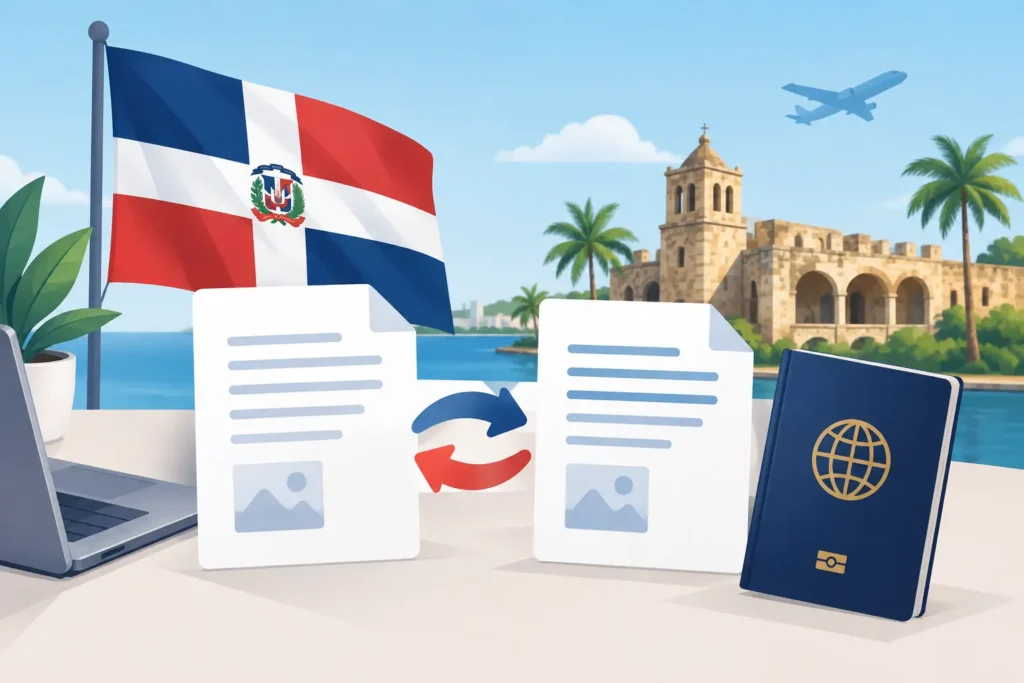
A residency application can be delayed by a document that looks perfectly acceptable at first glance. A birth certificate may be current, an FBI background check may be properly apostilled, and a marriage certificate may be original – yet the filing can still stop if the Spanish translation is incomplete, uncertified where certification is expected, or inconsistent with the underlying record.
When you translate documents for Dominican Republic immigration, translation is not simply an administrative task. It is part of presenting a coherent legal file to Dominican authorities. Names, dates, stamps, annotations, and even small formatting details must accurately carry over from the original document into Spanish.
Why Spanish translations matter in Dominican immigration filings
Dominican immigration processes are conducted in Spanish. Foreign-issued documents submitted in another language generally need to be accompanied by a Spanish translation so the receiving authority can review the record without relying on an informal interpretation.
This applies most often to the core civil and background documents used for visas and residency: birth certificates, marriage certificates, divorce decrees, police clearances, passport-related records, proof of income, pension letters, corporate documents, and documents supporting a minor child’s application. The exact list depends on your visa category, residency basis, nationality, and family circumstances.
A good translation does more than convert words. It preserves the legal meaning of the original. For example, a document showing a former name, a delayed registration, a divorce notation, or a court seal may affect how an immigration officer understands your identity and family status. Leaving out those details can create questions that take time to resolve.
What a Dominican immigration translation should include
A suitable immigration translation should be complete, readable, and tied clearly to the original document. Every meaningful element should be translated, including headings, marginal notes, seals, stamps, handwritten entries when legible, and official annotations. Dates and names should be rendered carefully, not “corrected” to fit a preferred spelling.
Personal names deserve particular attention. Your passport may show one version of a name while an older birth certificate, marriage certificate, or police certificate shows another. That does not always prevent a residency filing, but it needs to be identified early. A translator should reproduce the document faithfully, while your legal team can determine whether a supporting explanation, affidavit, or additional identity record is appropriate.
The translator’s certification may also matter. Depending on the agency, document type, and stage of the filing, authorities may expect a signed certification of accuracy and may require additional formalities. Requirements can change, and a translation that was accepted for one purpose is not automatically appropriate for another. A casual translation from a friend, an online tool, or an uncertified bilingual employee may be useful for your own review, but it may not be sufficient for an official immigration file.
Apostilles and translations: Get the sequence right
Many applicants understandably confuse apostilles with translations. They serve different functions.
An apostille authenticates the signature, seal, or capacity of the official who issued or certified a public document for international use under the Hague Apostille Convention. It does not translate the document or confirm that the content is accurate. A Spanish translation makes the document understandable to Dominican authorities, but it does not replace an apostille when legalization is required.
In many cases, the practical sequence is to obtain the original certified record, secure the apostille or required legalization in the issuing jurisdiction, and then arrange the Spanish translation of the full document package. That package may include the attached apostille page and any certifications or notes connected to it.
However, the best sequence can depend on the record and the authority receiving it. Some documents are issued electronically, some have multiple pages, and some need correction before apostille. Translating too early can mean paying twice if the document is reissued or if an apostille attachment changes the final package. A review before translation often saves time and avoids mismatched pages.
Documents that commonly require translation
Your exact requirements should be confirmed for your individual case, but applicants frequently need Spanish translations for foreign-language records such as:
- Birth, marriage, divorce, death, adoption, and name-change certificates
- FBI, RCMP, state, national, or other police clearance certificates
- Bank letters, pension statements, Social Security records, and proof of regular income
- Corporate formation records, shareholder documents, powers of attorney, and investment evidence
- School transcripts, diplomas, custody orders, and consent documents for children
Documents already issued in Spanish generally do not need translation. Documents issued in English should never be assumed to be exempt simply because English is widely understood. The question is whether the Dominican authority handling your case requires a Spanish version in the format it accepts.
Common problems that cause avoidable delays
The most frequent issue is incomplete translation. A translation may include the main certificate text but omit the registrar’s stamp, reverse-side notation, apostille, or certification statement. Immigration reviewers often need to see the entire record, not a simplified version of it.
Another common problem is inconsistency between documents. “John A. Smith” on a passport and “John Andrew Smith” on a birth certificate may be easy to explain. “John Smith” on one document and “Juan Smyth” on another requires closer review. Transliteration, married names, hyphenated surnames, and prior legal names should be addressed before the file reaches the submission stage.
Timing can also be a problem. Several immigration documents have limited validity windows, especially police certificates and financial evidence. If you wait until every document is collected before reviewing translation needs, a background check may expire while you correct a translation, obtain an apostille, or request a new certified copy.
Finally, avoid separating translations from their source documents. Keep the original record, apostille or legalization, and corresponding Spanish translation together in an organized file. Clear document control helps your legal representative prepare a complete submission and respond quickly if an authority asks for clarification.
A practical process before you submit
Start by making a document inventory based on the immigration route you plan to use. Identify the issuing country, language, date of issue, apostille status, and any name variations on each record. This initial review is especially valuable for families, investors using corporate documents, and applicants who have lived in more than one country.
Next, confirm whether the document needs a new certified copy before it is apostilled and translated. Do not rely on a scanned copy when the process requires an original or certified record. If a record contains an error, resolve that error with the issuing authority first. Translation should reflect the final legal document, not an outdated version you hope to replace later.
Then use a qualified Spanish translator who understands legal and immigration terminology. Ask that the translation cover all pages and attachments, and make sure the translated names, dates, document numbers, and issuing agencies match the original. If you have a deadline, allow time for quality review rather than treating translation as the last step before filing.
When professional coordination makes the difference
For a straightforward individual application, document translation may be relatively simple. For a family residency case, an investment-based application, a citizenship matter, or a file involving prior marriages, dual nationality, or overseas corporate records, the documentation can become more complex quickly.
That is where coordinated support matters. A local immigration team can review the document package in the context of the Dominican process, identify whether apostilles and translations are aligned, and flag inconsistencies before submission. Abreu & Associates provides this type of practical coordination as part of a broader approach to Dominican Republic immigration and relocation planning.
Before you send a document for translation, pause long enough to confirm its purpose, validity, and legalization status. A carefully prepared Spanish translation is not just a formality – it is one more way to make your move to the Dominican Republic clearer, more efficient, and easier to manage.