
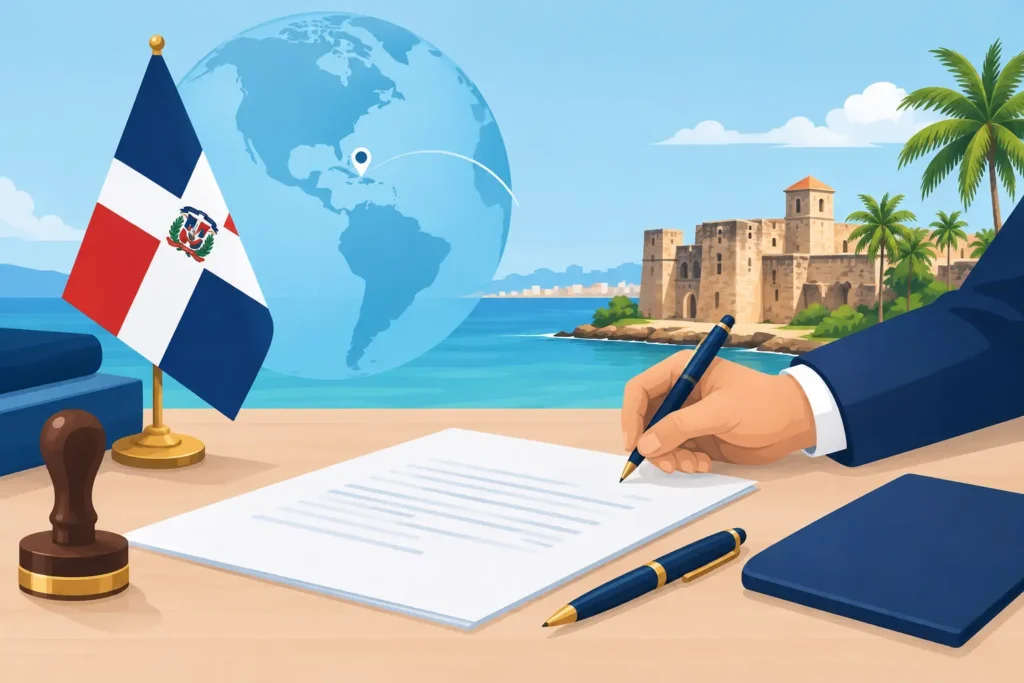
A flight delay, a family emergency, or a business commitment should not bring a Dominican Republic residency filing or property closing to a standstill. A properly prepared power of attorney can allow a trusted representative to act for you locally, but foreign power of attorney steps must be handled with care. A document that is valid in the United States, Canada, or another country may still be rejected in the Dominican Republic if its authority, authentication, translation, or wording is incomplete.
For foreign nationals, the goal is not simply to sign a form. It is to create a document that the relevant Dominican institution can accept for the specific task at hand. That may mean a residency application, tax registration, business incorporation, bank matter, real estate transaction, or document retrieval.
Start With the Exact Authority You Need
A power of attorney gives another person, often called the attorney-in-fact or representative, authority to act in your name. The safest approach is usually a specific power of attorney rather than a broad, open-ended document.
The required authority depends on the transaction. A representative handling an immigration process may need authorization to submit files, receive notices, sign certain administrative documents, and collect records. A real estate representative may require more detailed powers to sign a purchase agreement, transfer title, register a transaction, or manage funds. A business matter may involve authority before the tax authority, commercial registry, bank, or government agencies.
Using generic language can create unnecessary risk. An overly broad power may give a representative more control than intended, while a document that is too narrow may fail at the moment it is needed. The receiving institution may also have its own wording expectations. For that reason, the document should be drafted around the actual transaction before you sign it.
Foreign Power of Attorney Steps Before You Sign
The strongest documents are planned before the principal – the person granting the authority – visits a notary or consulate. Confirm the representative’s full legal name, nationality, identification number, and address, along with your own current identification details. Names should match passports and other supporting records exactly.
The document should clearly state what the representative can do, where the authority applies, and when it ends. If the power relates to a single property, company, immigration file, or bank matter, include identifying information that leaves little room for confusion. You can also limit the authority by time period, prohibit delegation to another person, or require your prior written approval for major actions.
Before signing, consider these practical questions:
- Does the institution involved require a special form or particular language?
- Will the representative need authority to sign, submit, receive, pay, or withdraw documents?
- Is the power intended for one transaction or ongoing administrative support?
- Should it end on a stated date, after a transaction closes, or upon written revocation?
For many clients, a bilingual document is useful. However, Spanish is generally the operative language for Dominican authorities. If an English-language power of attorney is used, an official Spanish translation may be required before it can be presented locally.
Sign Before the Appropriate Authority
A power of attorney signed outside the Dominican Republic must be formally executed according to the rules of the place where it is signed. In the United States, this commonly means signing before a notary public. Depending on the state and the authentication route, additional verification of the notary’s signature may be required before an apostille can be issued.
Clients sometimes assume that a notarized signature alone makes a document usable abroad. It does not. Notarization confirms the signing process, but it is the apostille or legalization process that helps foreign authorities recognize the public document.
If you sign at a Dominican consulate, consular procedures may be available for certain documents. In other situations, execution before a local notary followed by an apostille is the practical route. The correct method depends on the country of execution, the nature of the document, and the requirements of the Dominican entity receiving it.
Never sign a blank or unfinished power of attorney. Do not make handwritten edits after notarization without confirming how those edits will affect acceptance. A small discrepancy – such as a misspelled middle name, an omitted passport number, or an unsigned page – can delay a time-sensitive matter.
Obtain an Apostille or Consular Legalization
The Dominican Republic recognizes apostilles for documents issued in countries that participate in the Hague Apostille Convention. For many U.S.-issued powers of attorney, the apostille is obtained from the appropriate state authority after notarization. The process is not necessarily the same in every state, particularly where county-level authentication is required first.
Canada now also uses the apostille system, but the competent authority can vary by province or territory and by the type of document. Documents issued in countries outside the apostille system may instead need consular legalization. This process can involve more than one government office and may take longer.
The apostille must relate correctly to the signature and capacity of the official who notarized or issued the document. An apostille attached to the wrong version, an uncertified copy, or an incomplete original may not solve the problem. Keep the original together with its apostille, as Dominican institutions often need to review the complete physical document.
Translate and Prepare the Document for Dominican Use
Once the document arrives in the Dominican Republic, it may need an official translation into Spanish. The translation should cover the power of attorney and, where applicable, its apostille. A partial or informal translation can lead to questions about the scope of authority.
Depending on the matter, the document may also need to be notarized, filed, recorded, or attached to a legal dossier in the Dominican Republic. A power used for a residency process is handled differently from one used to purchase property or represent a shareholder. There is no single filing step that applies to every power of attorney.
This is where advance coordination matters. Sending an original document by international courier can be costly and slow, so it is worth confirming all language, execution, apostille, and translation requirements before it leaves your hands. A scanned copy may help a legal team review the wording, but it may not replace the apostilled original when the transaction requires original documentation.
Choose Your Representative Carefully
A power of attorney is a practical convenience, but it is also a grant of legal authority. Choose a representative with a clear role, a reliable local presence, and the experience appropriate to the task. For immigration and business matters, clients often appoint qualified Dominican legal counsel. For personal transactions, a trusted family member or business associate may be appropriate, provided the scope remains limited and clear.
It is wise to keep a signed copy, note the date and scope of the authority, and tell your representative what decisions require direct consultation with you. If circumstances change, revoke the power in writing and notify any institution that may have relied on it. Revocation procedures should be handled carefully, especially if the document was used in a registered or ongoing transaction.
A power of attorney can save considerable time when you cannot be physically present in the Dominican Republic. It should never be treated as a one-size-fits-all form. With document review, proper apostille handling, Spanish translation, and a carefully defined scope, Abreu & Associates can help ensure your authority is prepared for the Dominican process ahead.